Your digital EUDR due diligence statement
for your consignment

Due Diligence Statement (DDS) automated generation and submission

Due Diligence Statement

As CEO of Dilify Ltd, I hereby confirm that our analysis and processing of satellite data, geolocation information, and legality risk has been conducted in accordance with Article 9, 10, and where necessary, Article 11 requirements under Regulation 2023/1115.

Our assessment included:

1. Processing and validation of geolocation polygons for all source plantations, using high-resolution satellite imagery and Sentinel-2 data
2. Algorithmic change detection analysis to verify no deforestation or forest degradation occurred after December 31, 2020
3. Integration of plantation coordinates and production data into an EUDR-compliant format
4. Technical verification of data completeness and accuracy for submission through the EU information system
5. Digital tracking of chain of custody from plantation geolocation through processing and manufacturing to ensure record-keeping and prevent mixing with non-compliant materials
6. Assessment of compliance with relevant legislation in the country of production, including: Land use rights and tenure, Environmental protection laws, Labor rights and working conditions, Indigenous peoples' rights, Tax and anti-corruption regulations, Trade and customs requirements

This analysis below supports the documentation package for the EU Operator and provides the technical foundation for demonstrating negligible risk of non-compliance with Article 3 requirements. The full dataset and analytical methodology are available for review by the EU Operator and Competent Authorities.


Harris Karim
CEO, Dilify Ltd

Due Diligence Evidence

Artasia

G-292 Epip Sitapura Industrial Area, Jaipur, 302022

Shipment Ref:
A013-2024-25
Shipment Date:
30th November 2024
1
Total
Plots
0
Level 1:
Low
Risk
1
EU
Forest
Overlap
1
Level 2:
Low
Risk
Due Diligence File

This is the GeoJSON file that must be uploaded into the EU's Deforestation Due Diligence Registry

Article 9

Information Requirements
Product
A description, including the trade name and type of the relevant products as well as, in the case of relevant products that contain or have been made using wood, the common name of the species and their full scientific name; the product description shall include the list of relevant commodities or relevant products contained therein or used to make those products;
Input
Mango Sawn Wood. Product HS Code: 9403 (Includes Wood which is in scope of EUDR)
Quantity
The quantity of the relevant products; for relevant products entering or leaving the market, the quantity is to be expressed in kilograms of net mass and, where applicable, in the supplementary unit set out in Annex I to Council Regulation (EEC) No 2658/87 (20) against the indicated Harmonised System code, or, in all other cases, the quantity is to be expressed in net mass or, where applicable, volume or number of items; a supplementary unit is applicable where it is defined consistently for all possible subheadings under the Harmonised System code referred to in the due diligence statement;
Input
Net Mass: 30,670 Kgs
Country & Region
The country of production and, where relevant, parts thereof;
Input
Valsad, India
Geolocation
The geolocation of all plots of land where the relevant commodities that the relevant product contains, or has been made using, were produced, as well as the date or time range of production; where a relevant product contains or has been made with relevant commodities produced on different plots of land, the geolocation of all different plots of land shall be included; any deforestation or forest degradation on the given plots of land shall automatically disqualify all relevant commodities and relevant products from those plots of land from being placed or made available on the market or exported; for relevant products that contain or have been made using cattle, and for such relevant products that have been fed with relevant products, the geolocation shall refer to all the establishments where the cattle were kept; for all other relevant products of Annex I, the geolocation shall refer to the plots of land;
Input
Attached GeoJSON file: Mango Wood.GeoJSON. Date range of production: 1st September 2024 - 1st December 2024
Supplier Details
The name, postal address and email address of any business or person from whom they have been supplied with the relevant products;
Input
Artasia. G-292 Epip Sitapura Industrial Area, Jaipur, 302022. Tel: +(91) 141 2770777. Email: info@artasia.in
Buyer Details
The name, postal address and email address of any business, operator or trader to whom the relevant products have been supplied;
Input
Confidential
Deforestation-Free Evidence
Adequately conclusive and verifiable information that the relevant products are deforestation-free;
Input
There is clear evidence of negligible risk of deforestation due to the clear traceability of the mango wood from source to the manufacturing location as well as the satellite imagery evidence from December 2020 and November 2024 where vegetation increased.
Local Law Abidance
Adequately conclusive and verifiable information that the relevant commodities have been produced in accordance with the relevant legislation of the country of production, including any arrangement conferring the right to use the respective area for the purposes of the production of the relevant commodity
Input
There is clear evidence of the mango wood production following the laws of the land of production due to the clear documentation provided from source to transport across the supply chain. See Article 10 responses.
Supporting Certificates and Documents
Any documentation to prove the product was sourced from the geolocations provided. This can be FSC certificates or waybills or any other such collateral.
Input
There are various documents that have been analysed as part of the due diligence process which has supported the low risk conclusion for deforestation, traceability, and legality. Documents include farmer ID, land documents and titles, purchase invoices from the sawmill, stamp duty, weigh slips, waybills, invoices, and lorry check lists.

Article 10

Risk Assessment
Country Risk
the assignment of risk to the relevant country of production or parts thereof in accordance with Article 29
Input
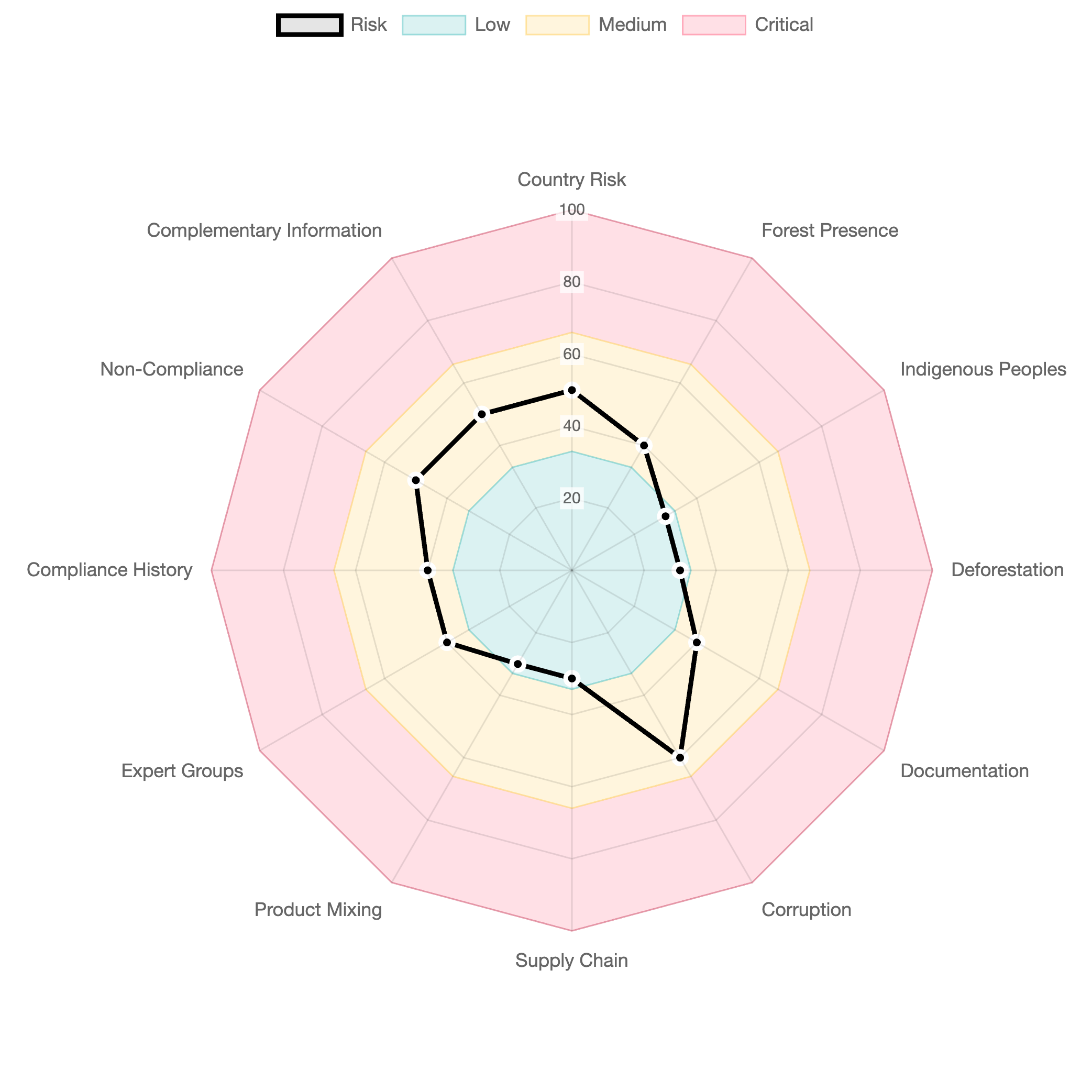
India is currently designated as a standard-risk country for EUDR compliance. While this necessitates appropriate due diligence, Gujarat's agricultural governance framework, as evidenced in the provided documentation, helps mitigate risks. The site's location in an established agricultural area near Valsad further supports controlled harvesting conditions
Forest Presence
the presence of forests in the country of production or parts thereof;
Input
The satellite imagery shows the site is situated in an agricultural zone with no natural forest conversion. Historical imagery confirms the mango orchard was established prior to December 2020, and the surrounding area shows stable agricultural land use patterns, supporting EUDR compliance requirements
Indigenous Peoples
(i) the presence of indigenous peoples in the country of production or parts thereof; (ii) the consultation and cooperation in good faith with indigenous peoples in the country of production or parts thereof; (iii) the existence of duly reasoned claims by indigenous peoples based on objective and verifiable information regarding the use or ownership of the area used for the purpose of producing the relevant commodity;
Input
For Indigenous Peoples considerations, while Gujarat has recognized tribal communities, this specific agricultural site near Valsad is not located in or adjacent to any designated tribal areas. Historical land records and local government documentation confirm long-established agricultural use without outstanding indigenous claims or conflicts
Deforestation
prevalence of deforestation or forest degradation in the country of production or parts thereof;
Input
The Deforestation analysis, supported by satellite imagery, shows no forest conversion at or around the harvest site since well before the December 2020 cutoff date. The area's stable agricultural land use history and clear documentation of orchard establishment support full compliance with EUDR deforestation-free requirements.
Documentation
the source, reliability, validity, and links to other available documentation of the information referred to in Article 9(1);
Input
The operation maintains comprehensive records including land titles, harvest permits, and transport documentation. While some regional documentation systems in India face challenges, this site's records demonstrate adequate traceability and verification capabilities. The combination of official documents, satellite imagery, and agricultural records provides reliable evidence for EUDR compliance assessment
Corruption
concerns in relation to the country of production and origin or parts thereof, such as level of corruption, prevalence of document and data falsification, lack of law enforcement, violations of international human rights, armed conflict or presence of sanctions imposed by the UN Security Council or the Council of the European Union;
Input
India's position presents moderate concerns, with Valsad being in Gujarat state which ranks in the middle range for governance indicators within India. India scores 40/100 on Transparency International's 2023 Corruption Perceptions Index, indicating some corruption risks remain. However, the additional documentation provided, including satellite imagery analysis and timber legality verification documents, demonstrates adequate local governance frameworks and transparent timber harvesting permits for this specific plot.
Supply Chain
the complexity of the relevant supply chain and the stage of processing of the relevant products, in particular difficulties in connecting relevant products to the plot of land where the relevant commodities were produced;
Input
Mango wood harvesting near Valsad involves a relatively straightforward process from orchard to initial processing. The supply chain documentation shows clear traceability from the harvesting site to primary processing, with detailed transportation permits and harvest records. The direct nature of this particular supply chain, with mango trees being harvested at end-of-life from agricultural land, reduces complexity-related risks.
Product Mixing
the risk of circumvention of this Regulation or of mixing with relevant products of unknown origin or produced in areas where deforestation or forest degradation has occurred or is occurring;
Input
While Gujarat's timber sector includes various wood sources, this specific case involves solely end-of-life mango trees from documented orchards. The site's harvest protocols and detailed log tracking systems, as evidenced in the provided documentation, effectively prevent mixing with timber from natural forests. The harvest records show consistent volumes matching permitted quantities, indicating strong controls against unauthorized mixing.
Expert Groups
conclusions of the meetings of the Commission expert groups supporting the implementation of this Regulation, as published in the Commission’s expert group register;
Input
The Gujarat Forest Department has established clear protocols for harvesting trees from agricultural land, which this operation follows. The compliance with these protocols, as shown through harvest permits and inspections, aligns with EUDR expert group recommendations for agricultural wood sourcing, supporting a positive risk assessment.
Compliance History
substantiated concerns submitted under Article 31, and information on the history of non-compliance of operators or traders along the relevant supply chain with this Regulation;
Input
Compliance History shows no significant violations in timber harvesting from this area over the past five years, according to local regulatory records. The operation has maintained consistent compliance with agricultural and timber transport requirements, as evidenced by their valid permits and positive inspection results. The documentation demonstrates a pattern of proper legal compliance
Non-Compliance
any information that would point to a risk that the relevant products are non-compliant;
Input
In terms of Non-Compliance risks, while some timber operations in Gujarat have faced challenges with forestry standards, this particular harvest involves documented agricultural land. The satellite imagery confirms no encroachment into forest areas, and the operation's procedures show adherence to agricultural wood harvesting requirements.

Region and Country Risk Assessment

Mango wood shipments from Gujarat, India present a moderate-low risk under EUDR. Gujarat has moderate forest cover and limited indigenous populations in the Valsad region, with relatively stable land use patterns focused on agriculture. The supply chain for mango wood is relatively straightforward, coming from documented agricultural land with end-of-life trees, reducing risks around product mixing and traceability. Documentation and compliance systems are generally adequate, though some improvements in record-keeping could be made. Overall, while India remains a standard-risk country, the agricultural nature of the wood source, clear land history, and established governance frameworks in Gujarat provide positive risk mitigation factors for EUDR compliance.
Consignment Risk Assessment

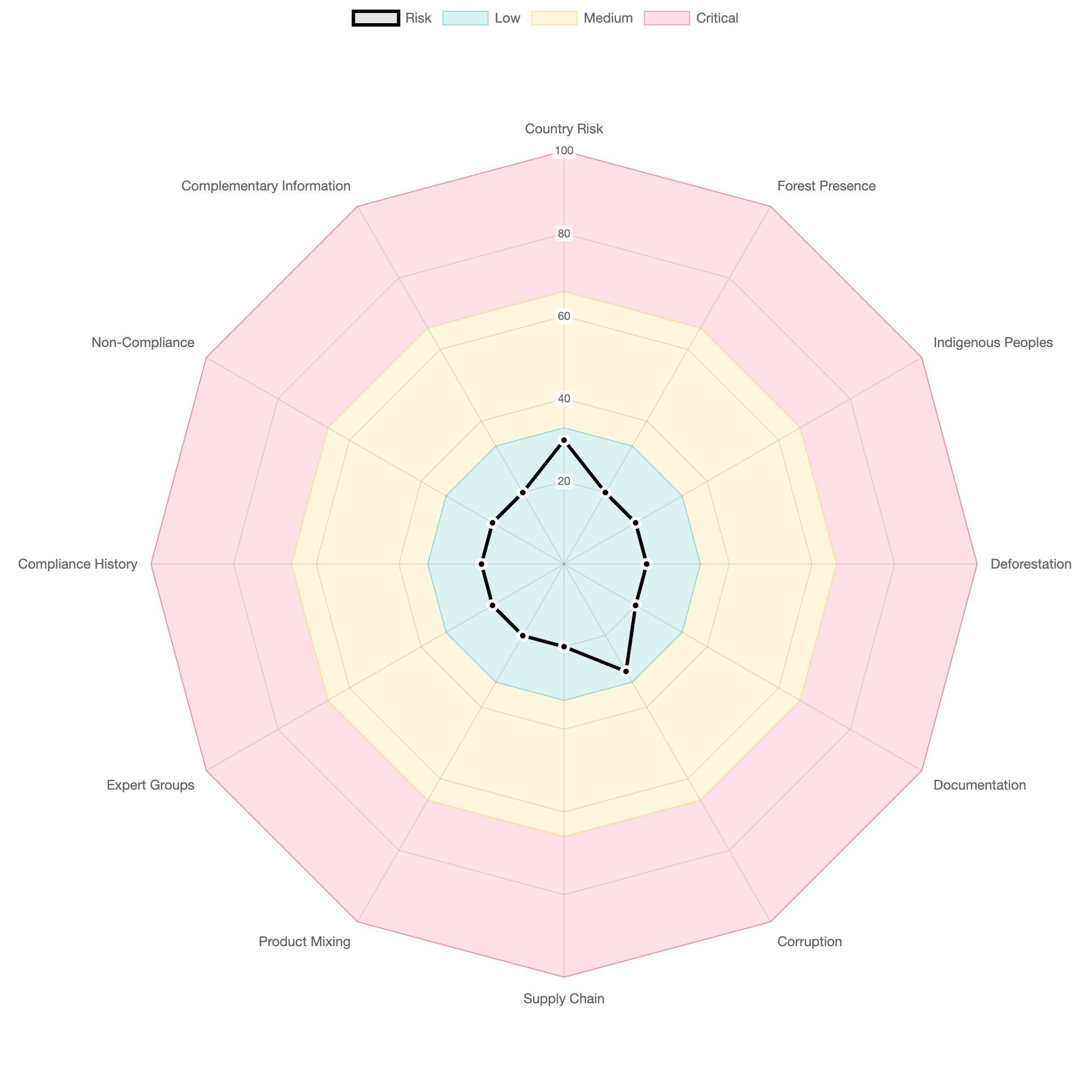
This mango wood consignment from Valsad presents low risk under EUDR. Sourcing from a single documented agricultural farm reduces supply chain complexity and product mixing risks. Comprehensive documentation including waybills, transport permits, sawmill licenses, and forest passes demonstrate complete traceability, effectively addressing key compliance concerns. While Gujarat's forest presence and agricultural land conversion require due consideration, the farm's established mango orchard status pre-dating 2020, verified through satellite imagery, mitigates deforestation risks. The consignment's clear provenance through detailed farmer identification, purchase invoices, and documented chain of custody substantially lower non-compliance risks. Overall, the combination of complete documentation trail and controlled agricultural sourcing conclude a negligible risk for EUDR compliance.

Traceability Summary

Summary of the detailed analysis and risk assessment of the supply chain and relevant documentation.
3
Total Actors within the Supply Chain
Actors identified, verified, and validated within the supply chain
100
Documentation Completeness %
Documentation coverage of certifications, farm registrations, licenses, permits, waybills, and purchase invoices
100
Geolocation Coverage %
Geographic verification with confirmed coordinates of the plot supported by satellite imagery
1
Volume Discrepancy % from Source to Export
Volume discrepancy detected between harvested & transported quantities through documentation (tolerance: <10%)

Deforestation Plot Summary

Summary of the plots
1
Total Plots
This is the total number of plots where the Product was produced from
0
Level 1: Low Risk Plots
This is the total number of LOW risk plots where the Product was produced from
1
Plots that overlap with EU Forest Map
Plots that are overlapping with the EU Forest Observatory map and requires further analysis
1
Level 2: Low Risk Plots
This is the total number of LOW risk plots after further analysis using our AI algorithm

Deforestation Plots that do not overlap with the EU Forest Map

These are the plots leveraging the Dilify platform which were deemed low risk of deforestation as they do not overlap with EU Forest Map.

Not Relevant

Deforestation Plot Analysis of High Risk Points

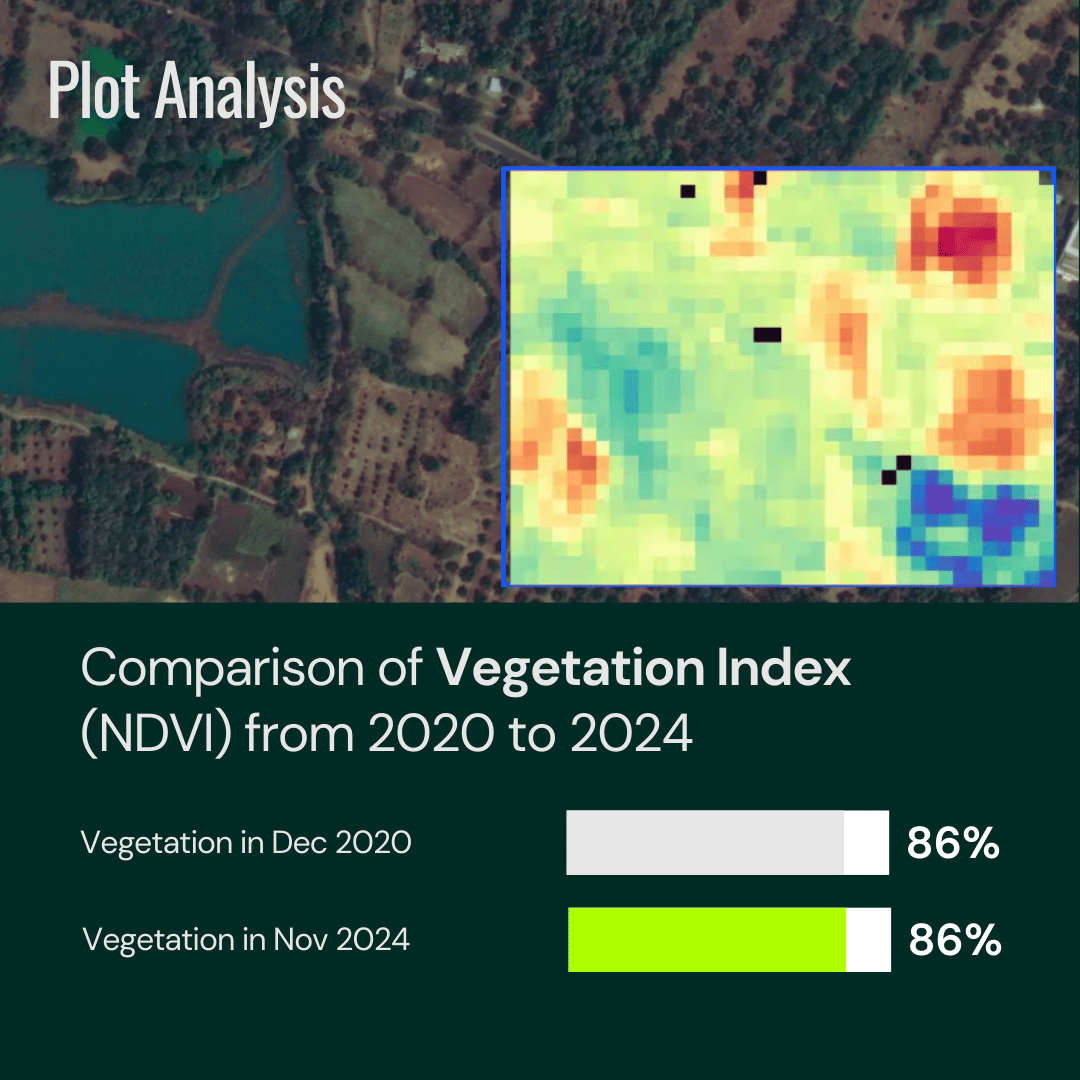
These are the points which were deemed high risk of deforestation from the EU Forest Map, however Dilify's proprietary AI algorithm has deemed these low risk with the evidence shown below from the Dilify platform.
Not Relevant

Deforestation Plot Analysis of High Risk Polygons

These are the polygons which were deemed high risk of deforestation from the EU Forest Map, however Dilify's proprietary AI algorithm has deemed these low risk with the evidence shown below from the Dilify platform.

Plot Name
Mango Wood
4
Total
Area (Ha)
85
EU Map
Overlap
%
100
AIgorithm
%
Description
The satellite-based vegetation analysis provides strong evidence that the mango orchard meets EUDR compliance requirements. Our detailed comparison between December 2020 and October 2024 confirms the agricultural nature of the land use and demonstrates no deforestation activity. The observed vegetation changes are consistent with typical seasonal variations in mango orchard management, such as pruning cycles and canopy development. The analysis covers the plot area and conclusively shows that no conversion from forest to agricultural use has occurred after the critical EUDR cutoff date of December 31, 2020.
Final Risk Outcome

Low Risk